
Data
Fit Is Almost Solved. Taste Isn't.
Half of all clothing returns are about size. An entire industry of scanners and algorithms is fixing that. Nobody is seriously working on the other half — the part where the shirt fits and you still look wrong.

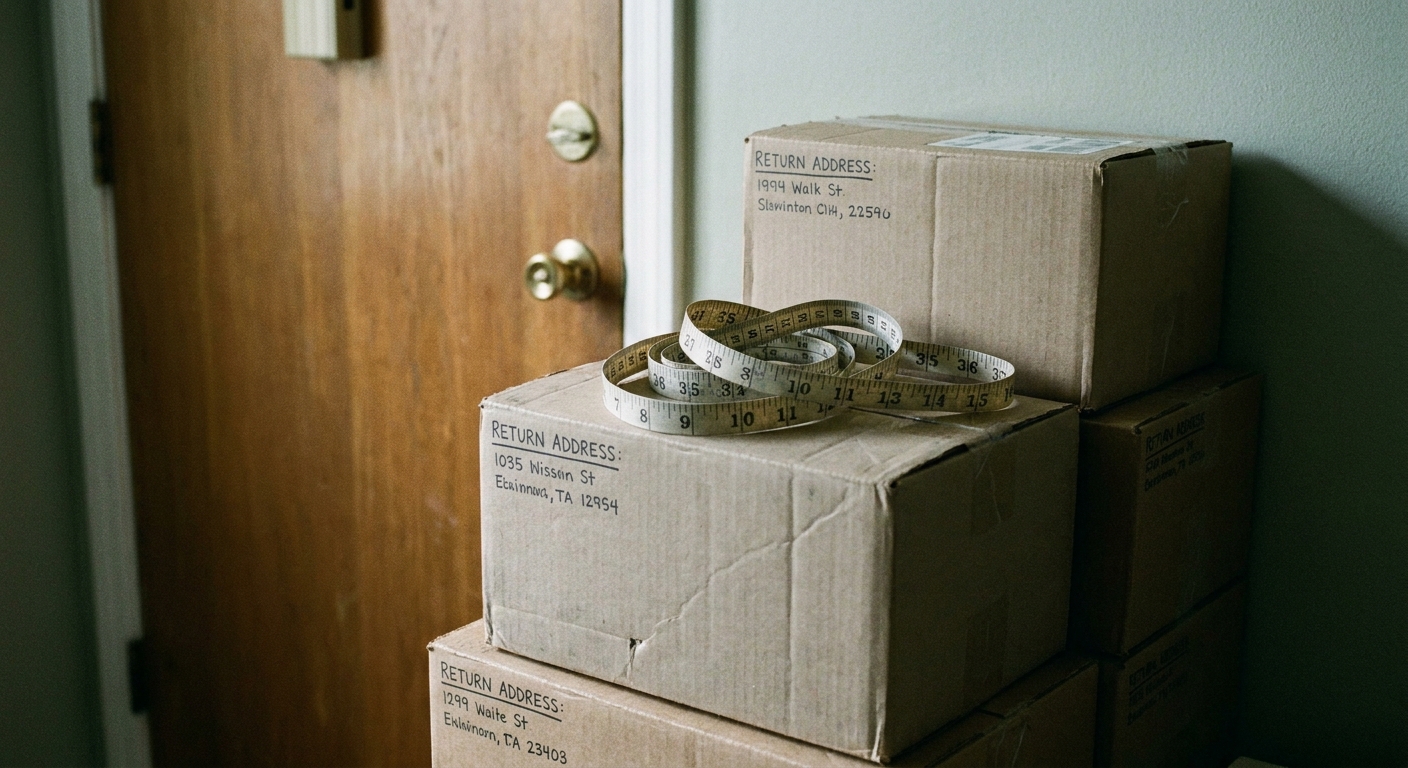
The apparel industry has an $890 billion humiliation it prefers not to discuss at parties: returns. US retailers expected 16.9 percent of everything they sold in 2024 to come back — nearly a fifth of retail, boxed up and shipped backward. And apparel runs hotter than retail overall: online fashion returns land in the 20-to-30 percent range, spiking past thirty in the holidays, with some European markets — Germany, famously — pushing forty-plus. Behind your building's package-room chaos sits one of the largest reverse-logistics operations in human history, and it exists mostly because clothes bought on screens don't survive contact with mirrors.
The industry's own diagnosis of why is unusually unanimous, and worth taking seriously — because it's about to run out.
The half that's getting solved
Ask the data why clothes come back and one answer dominates: fit. Sizing problems drive roughly 53 percent of apparel returns. Around half of online shoppers now "bracket" — order the medium and the large with premeditated intent to return one, using the bedroom as a fitting room and the courier as penance. Among Gen Z it's a majority behavior, 51 percent, which tells you bracketing isn't deviance anymore; it's the protocol. The system degraded until ordering one size of something started to feel naive, and everyone quietly adjusted. (Retailers, for their part, now report returns fraud as a mainstream problem — 93 percent of them, per the NRF. The whole loop is rotting from both ends.)
Here's the good news buried under the cardboard: the fit half of the problem is dying. Slowly, unglamorously, on schedule. Amazon alone generates billions of AI size recommendations every month, trained on fit feedback across nineteen locales. Fit-prediction vendors sit under the checkout flows of half of fashion e-commerce. The better midmarket brands now publish garment measurements — actual pit-to-pit numbers — like it's normal, because it finally is. Try-on avatars, whatever else you think of them, keep improving. This is exactly the kind of problem software reliably grinds down: bounded, measurable, and the same for everyone at a given set of measurements. Fit is a geometry problem, and geometry yields.
Give it five years and "will the medium fit me" will be a question your phone answers better than a fitting room. I genuinely believe that. And it should clarify everything, because of what's left standing when it's done.
The half nobody owns
Fit answers one question: does this garment match your body. It says nothing — nothing — about the questions that actually decide whether you look good:
- Does this go with anything you own, or is it about to become the orphan of your closet?
- Does it suit you — your build, your coloring, your age, the life you actually lead — or just the six-foot-one model it was photographed on?
- Is it right for the places you'll actually wear it, or for an imaginary calendar of gallery openings?
- Three trips from now, does it still make sense — or was it a costume for a self you tried on once and returned?
Call that cluster taste — coherence, judgment, whatever word doesn't embarrass you. The industry has no department for it. It used to: that was the department-store clerk, the good shop owner, the friend with the eye — a human layer that looked at the whole man and vetoed the mistake before the register. That layer was liquidated with the stores that housed it, and nothing digital replaced it. What we built instead is infrastructure that can now show you, with steadily improving fidelity, exactly how you will look in a mistake.
The proof taste is unsolved sits right in the returns data. Kill the 53 percent that's fit and you're left with millions of garments a year that came back even though they fit — the "not as expected," the "didn't suit me," the wordless "changed my mind." The wrong-for-me return. No scanner touches it. And the returns are only the visible fraction; the larger casualty ledger hangs in closets — the fits-fine-never-worn tier of every man's wardrobe, purchased with real money, worn twice, radiating quiet reproach. Nobody refunds those.
Fit is a geometry problem. Taste is a judgment problem. We solved the geometry first because geometry doesn't require anyone to have an opinion.
Items are how warehouses think
The deepest version of the mistake is selling clothes as items at all. Nobody wears an item. You wear four or five decisions simultaneously — shirt, trouser, shoe, jacket, the day's context — and they either agree with each other or they don't. The shirt that's perfect in the product photo can be wrong the moment it meets your only trousers; the sneaker that's right in isolation unbalances everything above it. A wardrobe isn't a collection. It's a system, and systems fail at the interfaces.
Items are how warehouses and websites think, because items are what ship in boxes. Outfits are how bodies leave the house. Every domain that professionalized — nutrition went from foods to diets, finance from stocks to portfolios — made this same move from unit to system. Clothing retail is the last big consumer category still selling exclusively at the unit level and acting mystified that a quarter of the units come back.
So if the taste layer ever gets rebuilt, we know where it has to sit: not at the product page but at the level of combinations — something with an opinion about the whole picture, accountable for the outcome rather than the SKU, that knows what's already in the closet before recommending what enters it.
When the geometry is free
Play it forward. Fit-tech finishes its grind; sizing failures asymptote toward zero; the try-on avatar becomes accurate enough to trust. Every remaining return, every closet orphan, every "I have nothing to wear" spoken into a full wardrobe becomes a pure, unobstructed taste failure — no longer deniable, no longer blameable on the size chart. The industry loses its last excuse, and so, frankly, do we.
I think that's when menswear gets genuinely interesting again. The century of selling men garments and washing your hands at the register is ending; the era of being answerable for how a man actually looks — the whole man, the whole outfit, the whole closet — is starting, whether the industry volunteers for it or not.
The measuring tape had a phenomenal run. The judgment business is hiring.
Theo Marsh is the editor of the Fresh Journal. Cleveland-raised, Brooklyn-based; former vintage buyer and recovering sneaker reseller. He owns four navy sweaters and regrets none of them.