
Essay
How Men Actually Learn to Dress in 2026
The dads taught nothing, the stores are gone, the forums are dead, and the algorithm is a salesman. A field report from the strangest era in the history of getting dressed.
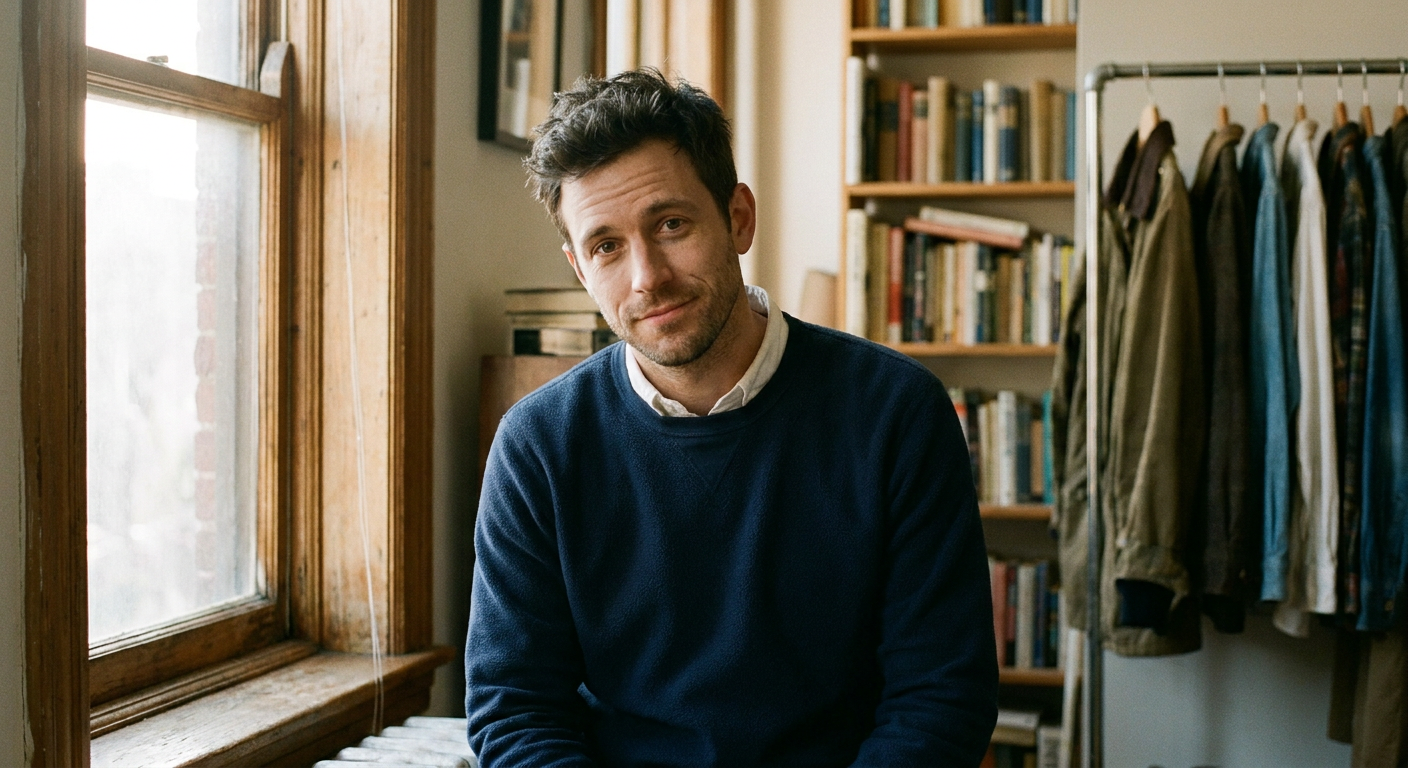
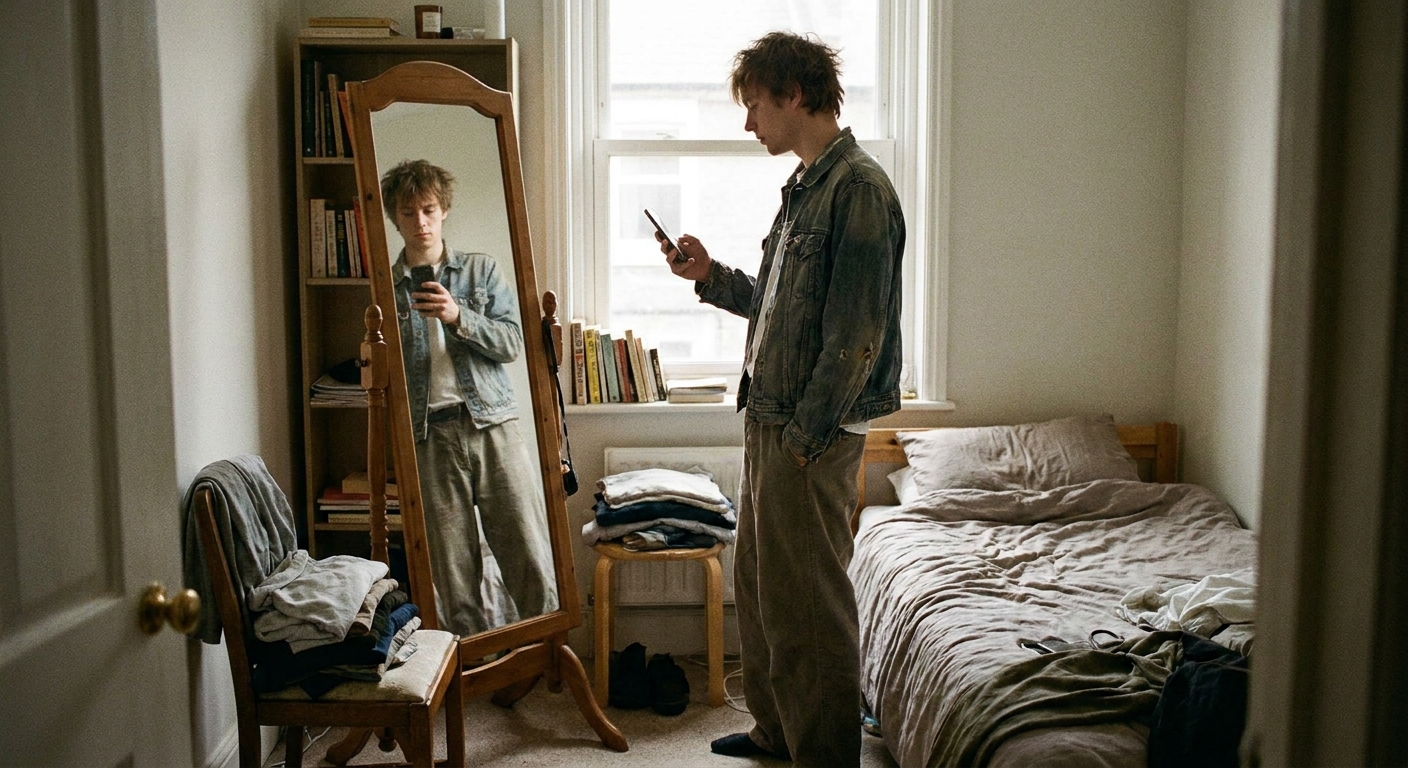
No man alive today was taught how to dress by the system that's supposed to teach him, because there isn't one. Strictly speaking there never was — no curriculum, no license, no class you could fail. But for most of the last century the informal apparatus worked so well nobody noticed it was an apparatus. You inherited a template: father, army, office — each one a uniform with a decade of adjustment baked in. A clerk enforced the details; Sol on the second floor kept you from the worst versions of yourself. And the range of acceptable outcomes was so narrow that falling far was actually difficult. The whole system asked nothing of a man but attendance, and in exchange it guaranteed him a C+, forever. Plenty of men lived and died happily at C+.
Every component of that machine is now gone. The dads went business-casual in the nineties and stopped transmitting — a whole generation raised by men whose entire style philosophy was "khakis." The offices stopped enforcing; the last dress codes died with the pandemic and did not return. The clerks were liquidated with the buildings around them, floor by floor, bankruptcy by bankruptcy. What replaced the apparatus is a phone. And the phone — this is the part worth being precise about — is not neutral. The phone, unlike Sol, is not on your side.
The curriculum nobody designed
Watch how a man under thirty-five actually learns clothes now, and you'll see the strangest curriculum ever assembled — brilliant in fragments, corrupt at the core, and nobody's in charge of it.
He learns vocabulary from, improbably, one guy on X. When Musk-era Twitter rewired its feed algorithm in late 2022, it began force-feeding the posts of a longtime menswear blogger named Derek Guy to millions of men who'd never asked; his following roughly doubled in three months, from fifty thousand toward the millions he holds now. The platform meant nothing by it. But the accident ran the most important experiment in modern menswear: offer men substantive, unsponsored knowledge about trouser rise and jacket length, at scale, and see what happens. What happened is they stayed. They screenshot him into group chats. The demand was always there; no institution had bothered to check.
He learns aspiration from fit-check culture — TikTok and Instagram running a distributed, unpaid academy of silhouette. A thousand mirror videos teach proportion by repetition the way no magazine spread ever managed, because the bodies are real and the stakes are visible. Say what you want about the format; it accomplished something the entire twentieth century couldn't: it made it normal for a man to care about clothes in public, out loud, without apology. That's a civilizational unlock, and it happened in about four years.
He learns skepticism the expensive way. The sneaker decade was a mass course in market dynamics — every L a lesson, every brick a tuition payment — and its graduates can smell manufactured scarcity through a screen. The dupe economy — seventy percent of Gen Z buys dupes, the hashtag has billions of views — is that skepticism weaponized: a generation running controlled experiments on whether the logo was ever the product. Whatever else you think of it, it's empirical.
And then he learns what to actually buy from — and here the curriculum collapses into its own funding model — the feed. Whoever paid. An affiliate list wearing the mask of journalism; an ad wearing the mask of a fit check; a creator whose rent depends on the click, recommending this week what he'll replace next week. Ask a man where the last three things he bought came from and watch his face as he reconstructs it: an ad he didn't clock as an ad, a link whose commission he never saw, a video whose enthusiasm was purchased. He doesn't fully know. That's not his failure. That's the design.
The tutor works on commission
I keep returning to a line from Blackbird Spyplane — the reader-funded newsletter that this month banned affiliate links from all its clothing coverage — about commission money creating "a clear conflict of interest" between recommender and reader. It's the plainest sentence anyone in menswear media has written this decade, and the conflict it names is not an edge case. It is the load-bearing wall of the entire system that currently teaches men what to buy. The magazines run on it — GQ's commerce operation is the business now, not a sideline. The creator economy runs on it; the platforms LTK and ShopMy move billions in fashion sales on tracked links. The AI wave inherited it wholesale: this summer, Bloomberg caught a $185-million shopping app claiming affiliate commissions on sales it never drove — the tutor not merely biased but billing for lessons it didn't teach.
None of the individuals are villains; most creators are honest and the disclosure rules mostly get followed. The problem is structural and simple: when advice is free, the advice is the ad. Sol's salary was in the suit's margin, and Sol had to face my grandfather again in a year, so Sol told the truth. The feed never has to face anyone. Its memory of you is a targeting parameter.
The best-informed, worst-advised generation
The result is the central paradox of dressing in 2026, and once you see it you see it everywhere. This is simultaneously the best-informed and worst-advised cohort of male dressers in history. He knows what gorpcore is. He can identify a lapel gorge from a thumbnail. He holds opinions about loomstate denim that would have gotten him elected president of a 2009 forum. He follows four accounts sharper than the entire fashion press of 1995.
And he stands in front of his own closet at 8:40 on a Tuesday with all of it buzzing in his head and no idea what to put on — because information was never the missing ingredient. Judgment was. Judgment that knows him: his clothes, his build, his budget, his actual Tuesday. Information scales for free and is everywhere. Judgment historically required a person who knew you — and the last institutions that employed such people at scale filed for Chapter 11, one after another, while the feed was teaching him the word "silhouette."
The priesthood newsletters prove men will pay for honest judgment — but a few tens of thousands of subscriptions against eighty million men is not a system; it's a lifeboat. The question hanging over all of it: can the honest version scale, or is conflicted advice simply what advice costs at scale?
Field notes, going forward
That's what this publication is for, if you've wondered why a software company keeps publishing essays with charts in them. Somebody should be writing the field notes on the strangest era in the history of getting dressed — the collapses, the migrations, the accidental experiments, the numbers under the vibes — from a desk that doesn't cash commission checks. The old apparatus taught attendance and guaranteed a C+. The feed teaches appetite and guarantees a transaction. Somewhere between them is the thing actually worth building: judgment, honestly funded, at the scale of everybody's Tuesday.
The mirror's still leaning against the wall. The man's still standing in front of it. Everything else about the picture is changing, and we intend to keep the record.
See you next week.
Theo Marsh is the editor of the Fresh Journal. Cleveland-raised, Brooklyn-based; former vintage buyer and recovering sneaker reseller. He owns four navy sweaters and regrets none of them.