
Money
The $200 Sweet Spot: Why Midmarket Menswear Is Eating Luxury
Luxury raised prices until the math broke. The interesting clothes — and the smart money — moved to the middle. Here's how to shop the shift.

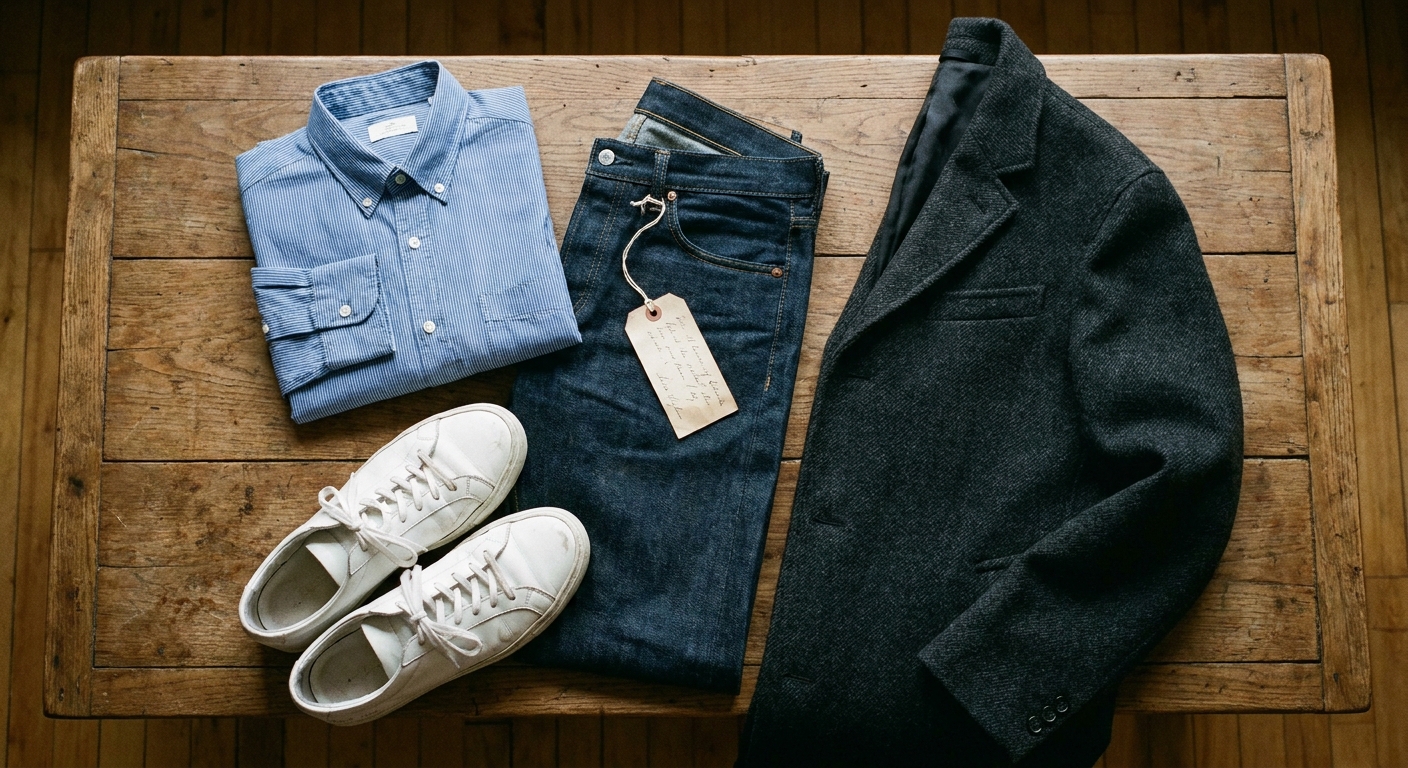
Somewhere in the last few years, without a press release, the center of gravity in menswear moved. Not downward to fast fashion — that story's ending, and badly — but sideways and slightly up, into the band where a shirt costs $120, a jacket costs $400, and the person who designed it can tell you which mill wove the cloth without checking. The industry calls it the midmarket. The money now calls it the fastest-growing segment in fashion. Most men still shop like it isn't happening, splitting their wallets between the $30 tee that dies in a season and the occasional guilt-priced logo purchase — which means most men are currently mispricing their own wardrobes.
Let me make the case with numbers, because for once the numbers are unambiguous.
The math that broke luxury
McKinsey's State of Fashion — the annual survey that functions as the industry's physical exam — now states it flatly: the midmarket is fashion's fastest-growing segment and is "replacing luxury as fashion's main value creator." For a document written by consultants for luxury's own executives, that sentence is a fire alarm.
The mechanism is arithmetic, not fashion. Luxury spent the post-pandemic years discovering it could raise prices — and then discovered it couldn't stop. Roughly 80 percent of luxury's growth from 2023 through 2025 came from price increases rather than volume. Same handbag, same jacket, bigger number, fewer buyers. You can run that play for a while; the flagship stores stay busy with tourists while the actual customer base quietly thins. Then the bill arrives: luxury economic profit fell 36 percent in 2024, and the segment's own consultants started writing sentences like the one above. The $600 logo tee was never a product strategy. It was a farewell tour with merchandise.
Meanwhile, the customer luxury priced out did something the spreadsheets didn't predict: he didn't trade down to disposable. He traded into the middle — where, over the same decade, a generation of direct-to-consumer menswear brands had been quietly compounding: real fabrics, real design, factories they'll name, prices with a visible relationship to cost. Todd Snyder. Buck Mason. Aimé Leon Dore at the fashion-forward end; Uniqlo anchoring the accessible floor; and between them a hundred smaller labels — the trouser specialists, the knitwear guys, the one-factory boot brands — competing on quality because they can't afford to compete on logo.
My favorite detail in the whole landscape, because it inverts every assumption about how fashion brands grow: Buck Mason — reportedly around $125 million a year now — cut marketing from about twenty percent of revenue in its early days to roughly seven percent, its founder dismissing "Excel-spreadsheet marketing" in favor of products people tell each other about. In an industry that treats attention as oxygen, the middle is winning partly by making better things and shutting up about it. That's not a marketing strategy; that's what product-market fit looks like when the product is a really good t-shirt.
The tariff clock
There's a reason to act on this rather than file it away: the middle is about to get repriced. In that same McKinsey survey, 71 percent of fashion executives said they plan to raise prices in 2026 — up nineteen points from the year before — with tariffs and trade disruption the leading cause; 45 percent of North American executives expect increases above five percent. Forty percent now rank trade flows a top-three business risk, a figure that jumped twenty-five points in a single year.
The stable, honest middle of the market — the tier that prices closest to cost, and therefore has the least margin to absorb a tariff — is exactly where those increases land visibly. The $128 oxford becomes the $145 oxford. It'll still be worth it. It just won't wait for you.
Cost-per-wear, the only spreadsheet that matters
The way to shop this shift isn't "spend more." It's a different denominator. Price-per-wear, not price — the math every well-dressed older man does instinctively and almost nobody writes down:
Three shirts, honest math
Illustrative numbers; the wear count is the honest variable nobody prints on the tag.
Cost-per-wear rewards exactly what the midmarket sells: durable construction, versatile design, and — the underrated one — things quiet enough to repeat twice a week without anyone noticing. It punishes both extremes symmetrically. Fast fashion fails on the numerator's lifespan; the denominator collapses when the collar quits in month four. Logo luxury fails on repeatability; a $400 statement piece is a statement you can only make so often, and ego depreciation is real — the piece that felt essential in the store and conspicuous by October.
But the formula has a catch, and the catch is the entire game: cost-per-wear only works if you actually wear the thing, and whether you wear it depends on what it goes with. A $120 oxford that matches five things you own will hit a hundred and fifty wears without trying. The same shirt in the wrong shade for your existing closet gets worn four times and becomes the most expensive garment you own on a per-wear basis, regardless of its quality. The industry sells items; your cost-per-wear is determined by combinations. Every wasted purchase in your closet — go look — failed at the combination level, not the item level. It was a good shirt. It just never found its trousers.
Which means the real skill of shopping the midmarket isn't brand knowledge, it's portfolio knowledge: buying the piece whose denominator your existing wardrobe will feed.
The window
Every so often the market hands the customer an era where the incentives briefly line up in his favor. This is one. Luxury is busy pricing itself into a corner it can't gracefully exit — prestige pricing is a ratchet; you can't un-raise it without admitting the whole game. Fast fashion's subsidy era is ending under tariffs and de minimis reform. And in between sits a decade-deep bench of midmarket brands at the peak of their quality-to-price ratio, about to pass through a repricing that will make current tags look generous in eighteen months.
The move isn't to buy more. It's to buy middle — deliberately, denominator-first, portfolio-aware — while the middle is still this good and still this priced. The best wardrobe of your life is currently sitting between $80 and $450 an item, waiting for you to stop scrolling past it in both directions.
The window's open. Windows close. That's what makes them windows.
Theo Marsh is the editor of the Fresh Journal. Cleveland-raised, Brooklyn-based; former vintage buyer and recovering sneaker reseller. He owns four navy sweaters and regrets none of them.